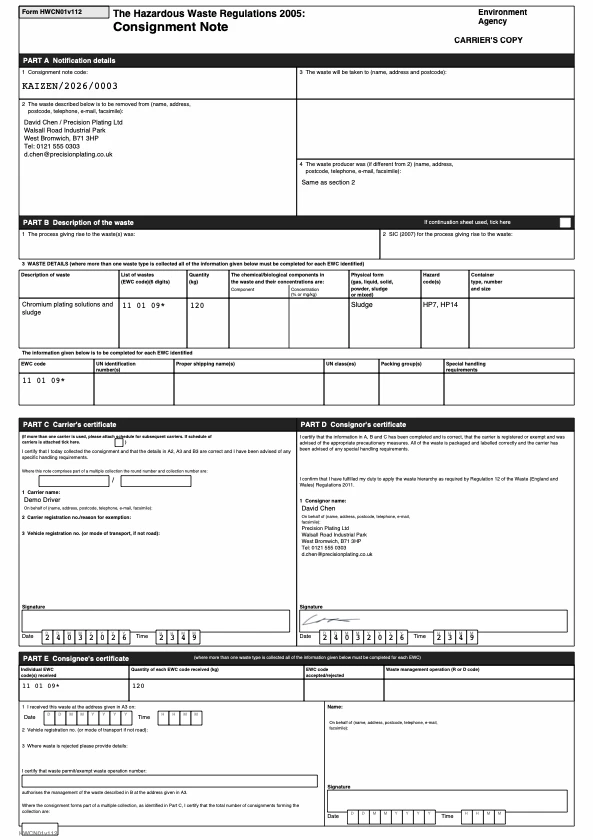
Every move of hazardous waste in England and Wales needs a hazardous waste consignment note. The form to use is the HWCN01, published by the Environment Agency. Get it wrong and you risk enforcement action, fines, and hold-ups at the receiving site. Get it right and it is simple, once you see how the five parts fit together.
This guide goes through each part of the form, says who fills in what, and flags the most common mistakes that cause compliance problems. It also shows how to create a hazardous waste consignment note from scratch, on paper or digitally. If you would rather skip the paperwork, digital consignment note software makes a compliant HWCN01 for every move on its own.
When do you need a consignment note?
You need a consignment note any time hazardous waste leaves a site. It does not matter how much there is, what type it is, or whether it goes to a treatment plant, a transfer station, or straight to disposal. The law behind this is the Hazardous Waste (England and Wales) Regulations 2005.
Fill in the note before the waste leaves the site, and keep it with the waste. Each party fills in their own part: the consignor (producer), the carrier, and the consignee (receiving site).
How to create a hazardous waste consignment note
You create a hazardous waste consignment note before the waste is collected, not after. The consignor starts it by filling in Parts A and B, then it travels with the load so the carrier and the receiving site can add their parts. It must use the HWCN01 form from the Environment Agency. Any note that does not match that form is not valid.
To make one, you put together the same details the form asks for: a unique consignment note code, the consignor's name, address and SIC code, where the waste is going, the EWC code and hazard codes, what the waste is made of, how it is packed, and the quantity. The parts below show exactly what goes in each field.
There are two ways to do it. You can write out the official paper HWCN01 by hand for every move. Or you can use digital consignment note software, which builds a compliant HWCN01 in minutes: it prefills your saved details, checks the entries, and gives you a finished note to print or share. You can see the format first with our free generator, then create your own notes by starting a free trial.
Part A: Notification details
Who fills it in: The consignor (the person or business producing or holding the waste).
Part A sets out the basic details of the move. The consignor gives:
- Consignment note code: A unique reference for this move. It works differently in England and Wales. In England, the first six characters come from your business name, so "Acme Oils" becomes ACMEOI, then a slash and five more characters to make it unique, like ACMEOI/00001. England stopped registering hazardous waste premises in 2016, so there is no premises code to use here. In Wales you must still register your premises with Natural Resources Wales, and the six-character premises code they give you starts the code instead, like ABC123/00001.
- The consignor's details: Name, address, postcode, and SIC code (Standard Industrial Classification) for the site where the waste was made.
- Collection address: Where the waste will be picked up, if it is not the consignor's registered address.
- Waste destination: The name, address, and permit or licence number of the site the waste is going to.
- What made the waste: A short note on the activity that produced it, for example "vehicle servicing" or "laboratory analysis".
Part B: Description of the waste
Who fills it in: The consignor, often with help from the carrier or a waste advisor.
This is the most technical part of the form. It needs an exact classification of the waste:
- EWC code: The six-digit European Waste Catalogue code for the type of waste. For example, 13 02 05* is mineral-based non-chlorinated engine, gear and lubricating oil. The star means it is hazardous. The wrong EWC code is one of the most common errors on a note.
- Physical form: Whether the waste is a liquid, solid, sludge, powder, mixed, or gas.
- Hazard codes: The hazardous property codes that apply, for example HP3 (flammable), HP7 (carcinogenic), or HP14 (ecotoxic). One waste can have more than one.
- What it is made of: The parts of the waste and roughly how much of each, especially the parts that make it hazardous.
- Containers: How the waste is packed, such as drums, IBCs, skips, or tanker compartments, and how many there are.
- Quantity: The estimated weight in kilograms or volume in litres.
Not sure which EWC code to use? Use our free EWC code checker to find it in seconds, then check the EA's waste classification guidance (WM3) for the full rules. Using a vague catch-all code when a more exact one exists is one of the top reasons notes get flagged at inspections.
Part C: Carrier's certificate
Who fills it in: The waste carrier, at the point of collection.
When the carrier turns up to collect, they fill in Part C to confirm they have taken the waste as described in Parts A and B. This part needs:
- Carrier details: The registered name and address of the waste carrier business.
- Carrier registration number: The carrier's registration number from the Environment Agency. It must be current. An expired registration is a criminal offence.
- Vehicle registration: The number plate of the vehicle carrying the waste.
- Mode of transport: Usually "road", but it could be rail, sea, or inland waterway.
- Date and time of collection: When the waste was actually picked up.
- Signature: The carrier, usually the driver, must sign to confirm they took the waste. An unsigned Part C means the note is incomplete.
Part D: Consignor's certificate
Who fills it in: The consignor (the waste producer or holder).
Part D is the consignor's declaration. By signing it, the consignor confirms that:
- The information in Parts A and B is correct.
- They have met their duty of care under Section 34 of the Environmental Protection Act 1990, which means taking reasonable steps so the waste is handled, moved, and disposed of properly.
- The waste has been correctly described, classified, and packed for safe transport.
The consignor signs and dates this part. In practice, they often sign while the carrier fills in Part C, during the collection.
Part E: Consignee's certificate
Who fills it in: The consignee (the receiving facility).
When the waste reaches the destination site, the consignee fills in Part E. This covers:
- Confirming receipt: The date and time the waste arrived, and the amount actually delivered (which can differ from the estimate in Part B).
- Checking the EWC code: The consignee checks the waste against the EWC code in Part B. If it does not match, they must note the difference and can reject the load.
- Permit or licence number: The environmental permit the receiving site runs under.
- Waste management method: The disposal or recovery code for how the waste will be handled, for example D10 (incineration on land) or R1 (use as a fuel).
- Signature: The consignee signs to confirm they received and accepted the waste.
Common mistakes to avoid
These are the errors the Environment Agency sees most often at inspections and audits. Any one of them can lead to enforcement action:
- Missing or wrong EWC codes: Using a vague code when a more exact one exists, or leaving it out. The EWC code must match the waste type and where it came from. If you are unsure, check the EA's waste classification guidance.
- Wrong hazard codes: Putting the wrong hazard code, or missing one that applies. Waste can have more than one hazardous property, and you must list them all.
- Unsigned forms: Every part that needs a signature must be signed. An unsigned Part C or Part D makes the note incomplete, which breaks the rules even if the waste was handled correctly.
- Missing carrier registration number: The carrier's registration number must be on every note. Leaving it off, or using an expired one, is a common and easy mistake to avoid.
- Blank or missing Part E: The receiving site must fill in their part. If your copy has a blank Part E, chase the consignee, because you need a finished note for your records.
- Not keeping records: Under Regulation 49, everyone must keep their copy for at least three years. Lost or missing notes count as compliance failures at inspections.
For more on these traps, read our full guide on 7 common mistakes waste carriers make.
A simpler way to get it right
A consignment note has a lot of fields, several people, and plenty of room for mistakes. Digital systems cut that risk: they prefill saved details, check entries before you finish, and store completed notes for the years the law needs.
Consigns makes compliant HWCN01 consignment notes digitally, with guided entry, on-site signatures, and a finished PDF. It checks the required fields before you finish, and stores every note for at least 3 years. Start a 14-day free trial. Cancel any time.